
How One Law Governs Casino Texts and a Completely Different Rule Governs the Pings From the Same App
Updated: · MyMobiCasino editors
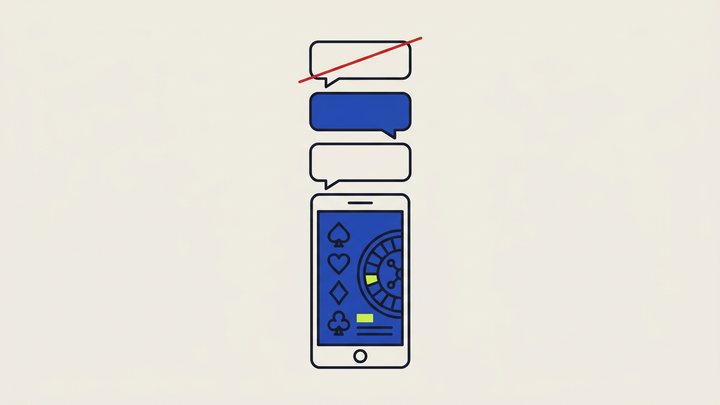
The promotional text message that lit up your phone at 2 a.m. is governed by a law that turned ten years old last July. Canada's Anti‑Spam Legislation came into force on 1 July 2014 and, from that day, every commercial electronic message a casino sends to an Ontario number—or any Canadian number—has had to carry identification, proof of consent, and an unsubscribe mechanism that works for at least 60 days. Push notifications from the same casino's app sit outside that law entirely. They are controlled in a few thumb taps on your device, not in the statute. That split is the one thing a player who wants the messages to stop needs to understand before anything else.
On this page 4 sections
The CASL Rulebook: Consent, Unsubscribe, and the Ten‑Day Clock
CASL draws a bright line around any electronic message that encourages participation in a commercial activity—opening a casino account, claiming a bonus, wagering. If it lands in an SMS inbox or an email folder, the sender must identify itself and include a working unsubscribe mechanism. No exceptions. The CRTC has been explicit about that since the law took effect, and every Canadian internet‑registry operator is expected to comply.
Who can send what turns on consent. Express consent is what it sounds like: a player checks a box, confirms a preference, or otherwise signals a clear affirmative action. Implied consent is narrower and has a shelf life. The CRTC states that any business or non‑business relationship created after 1 July 2014 is subject to the implied‑consent time periods laid out in CASL. A casino you played at once does not get a perpetual pass to text you; the clock starts ticking the moment the relationship begins, and when it runs out the messages must stop unless fresh express consent is collected.
The unsubscribe mechanism is where theory meets muscle. CASL requires that the opt‑out must be easy to access and use, and it must cost nothing. For email, a single click‑through link satisfies the requirement. For text messages, the law is more specific: a recipient has to be able to unsubscribe both by replying STOP and by following a link to a web page. That dual requirement is a practical guard against spoofed numbers—if the link is phony, the STOP still works.
That link has a mandatory lifespan. It must remain valid for at least 60 days after the message is sent. The moment you hit unsubscribe, the 10‑business‑day clock starts. The CRTC's published rule is unambiguous: a request to stop receiving commercial electronic messages must be honoured within that time. It means a casino that drops a promotional SMS on a Monday morning has until the Monday after next to cut you off entirely. If the messages keep coming past that point, the sender is in breach.
Push Alerts: A Completely Separate Settings Puzzle
App push notifications fall outside CASL's definition of a commercial electronic message because they do not travel through an electronic address the way SMS or email do. They are routed through a platform‑specific notification service—Apple Push Notification service or Google's Firebase Cloud Messaging—and they land on your lock screen under a different legal framework. The CRTC does not treat them as CEMs, and the opt‑out rules that govern text messages do not apply.
Turning them off is a device‑settings exercise. On an iPhone, open Settings, tap Notifications, select the casino app, and switch off Allow Notifications. That single toggle kills the banners, badges, and lock‑screen alerts. Android follows almost the same path: Settings > Apps & notifications > see all apps, pick the casino app, hit Notifications, and turn the toggle off. Some operators lace their own in‑app preferences menu with a notification slider, but the system‑level switch overrides it every time.
Because push alerts are controlled through the operating system, a self‑exclusion notice filed with a regulator does not automatically disable them on a phone the player still holds. The operator may stop sending push payloads from its server, but the safest route is to turn them off yourself. That split—statutory obligations for texts, DIY settings for alerts—is what catches up even experienced players.
Ontario's Self‑Exclusion Shield and Where to File a Complaint
In Ontario, the Alcohol and Gaming Commission has layered an extra set of protections onto the federal spam regime. The Registrar's Standards for Internet Gaming treat direct messaging via social media, email, text, and phone calls as marketing. That means the AGCO's anti‑spam expectations run alongside CASL, not instead of it.
Operators must, as soon as is practicable, take all reasonable steps to prevent marketing material, incentives, or promotions from being sent to a self‑excluded individual for the duration of the exclusion. The centralized self‑exclusion programme adds a deadline: marketing to a self‑excluded person must stop within 24 hours of registry entry. That 24‑hour window is written into the AGCO's information bulletin and applies to every registered iGaming operator in the province.
If a casino ignores those rules, the complaint channel depends on the type of message. For texts and emails that appear to breach CASL, the CRTC's Spam Reporting Centre is the national intake point. Consumers submit the offending message and the sender's details; the Commission can impose penalties for violations. For Ontario‑licensed casinos that market to a self‑excluded player in defiance of the Registrar's Standards, the AGCO itself is the recipient of that complaint—and it can suspend or revoke an operator's registration.
Common Questions
Can an online casino send me a promotional text without my permission? Only if it has express consent or valid implied consent that falls within the statutory window, and the message must carry identification and an unsubscribe mechanism. A cold text from a casino you have never dealt with is a CASL violation.
If I self‑exclude in Ontario, can the casino still market to me? No. The AGCO's standards require the operator to stop marketing material, incentives, and promotions from reaching you. For the centralized self‑exclusion registry, that must happen within 24 hours of your name being entered.
Are push notifications the same as SMS under CASL? They are not. Push alerts are handled through your phone's operating system, not through the electronic‑address framework that CASL regulates. The switch that silences them is in Settings, not in a spam‑law complaint.
The next time a casino message lands on your phone, the question to ask is not whether it is annoying—it is whether the sender got proper consent, identified itself, and gave you a working STOP that lasts 60 days. If the message came through an app's push channel, the answer is not in the statute. It is in a toggle you can flip right now.
Sources
- CRTC: Infograph
- CRTC: Guide
- University of Alberta, Canadian Anti-Spam Legislation Guide: Canadian anti spam legislation
- AGCO: Information bulletin agco sets igaming standards centralized self exclusion program
Rules, fees and app availability change. Check the current terms with your bank, your phone platform or the operator before you rely on them.
Keep reading
 Play safelyLost Phone with a Casino Account: Remote Lock, Erase, and Freeze—What to Do in OrderThe first thing to do when a phone carrying a logged-in casino or betting app vanishes is mark the device as lost and, if…
 Play safelyOntario's iGaming Standards Require Operators to Interrupt Your Play — Here's How Those Reminders WorkOntario's Alcohol and Gaming Commission has put one principle at the centre of its iGaming rules: a player who is losing track of…
 BankingYour Bank Didn't Say You're Broke. It Saw MCC 7995.A Canadian bank can decline an online casino deposit immediately after you tap confirm, while your chequing account holds four…